
Case studies · Heavy Civil Infrastructure
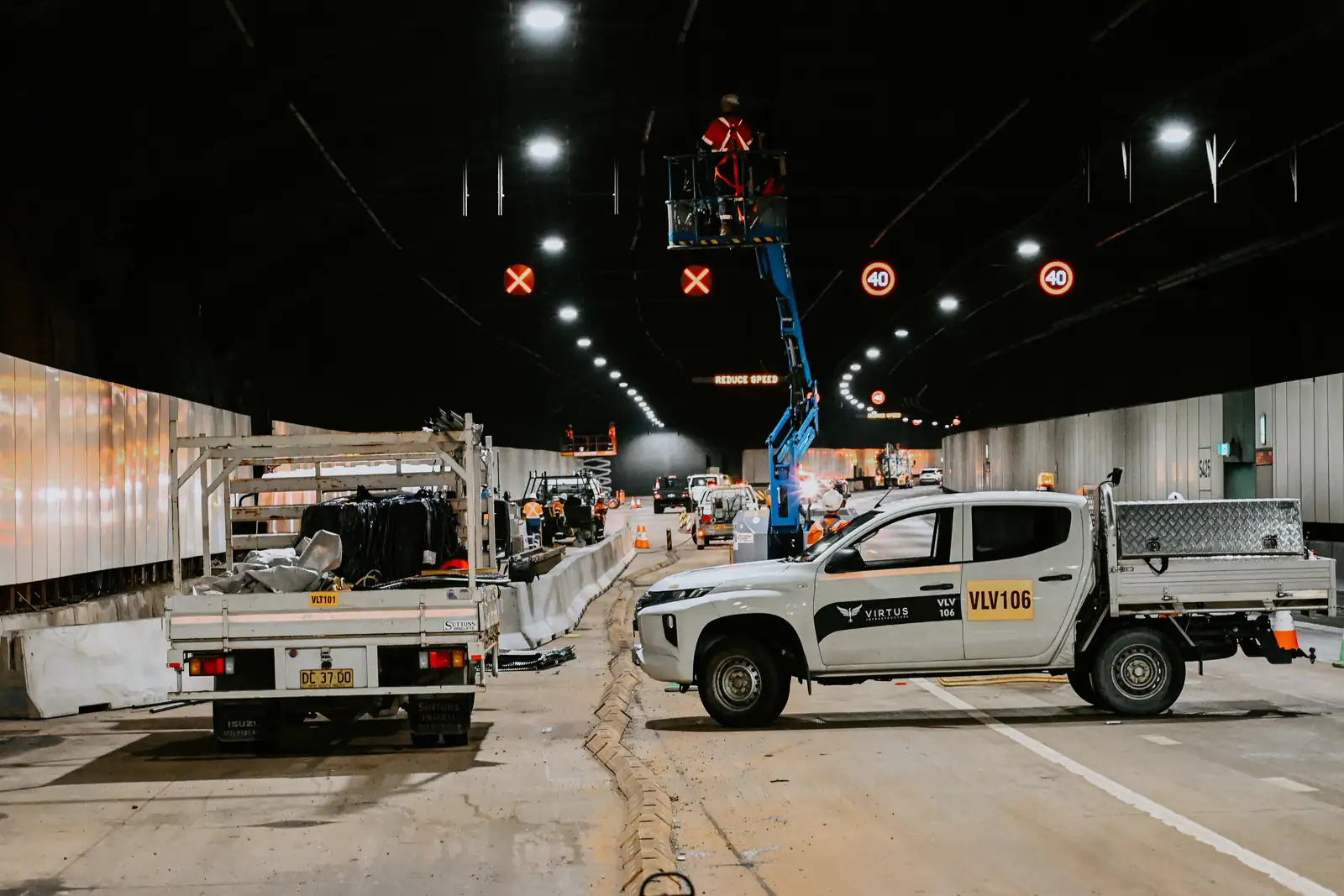
Tunnel Maintenance Across Sydney's Motorway Network
Virtus Infrastructure
- 0missed proof-test deadlines across 8 tunnels in the first 12 months
- 23%reduction in closure hours
- 48 hrsto compile a post-event damage assessment, down from 3 weeks
About the client
Virtus Infrastructure is a specialist engineering and maintenance contractor responsible for the operational upkeep of critical motorway assets across Sydney. Their portfolio includes some of the city's busiest and most complex tunnel systems, where mechanical ventilation, fire suppression, emergency lighting, drainage and structural lining must all be maintained within strict regulatory windows, often during limited quarterly closure periods.
With a workforce of engineers, tunnel technicians and safety specialists, Virtus manages everything from routine inspections to major shutdown maintenance programmes. Before AssetStack, that work was coordinated across four separate systems, a shared drive full of PDF inspection reports, and a spreadsheet-based forward works programme that was rebuilt manually every year.
The challenge
Managing tunnel safety systems in silos
Each tunnel in Virtus's network carries six independent safety-critical systems (mechanical ventilation, fire detection, smoke extraction, emergency lighting, water suppression and drainage), each with its own maintenance schedule, proof-test interval and compliance requirement. These were tracked in separate CMMS modules, with no connection to the structural condition of the tunnel lining or pavement.
“We knew the fire suppression system was due for a proof test. We knew the lining had cracking in Chainage 1,200. But we had no way to see whether the two were related, or whether a closure window could address both.”
Quarterly closures planned by spreadsheet, not by condition
Virtus programmes quarterly tunnel closures for major maintenance, incorporating pavement rehabilitation, structural repairs and safety system upgrades within existing closure regimes to avoid additional disruption. But without an integrated view of asset condition, scheduling was driven by calendar dates rather than actual need. A closure might repave a section while missing a deteriorating expansion joint 200 metres away.
Post-event assessment took weeks
After heavy rain events or incidents, Virtus needed to compile damage reports across multiple tunnels and bridges. With baseline condition data scattered across consultant PDFs and inspection photos stored in folder structures that varied by technician, comparing "before" and "after" took weeks. By the time the report was compiled, the next weather event had often arrived.
Capital planning with no live condition link
The forward works programme, used for client reporting and regulatory submission, was a static spreadsheet rebuilt annually. When a new Level 2 bridge inspection identified critical defects, or a tunnel safety system failed a proof test, the capital plan could not adapt. The team was planning next year's work with last year's data.
The solution
AssetStack was deployed as Virtus's integrated tunnel and bridge asset intelligence platform, replacing the fragmented tool stack with one system where structural condition, safety system compliance, pavement data and capital planning all live together.
Integrated Tunnel Safety System Register
Every tunnel was broken down into its component systems: structural lining, pavement, ventilation, lighting, fire suppression, drainage and ITS. Each system carries its performance standard, proof-test interval, last test date and next due date. Overdue tests and bypassed systems surface automatically, before they become safety incidents or regulatory breaches.
ARRB-Aligned Inspection Management
Level 1, 2 and 3 inspections for bridges and tunnels are now conducted through AssetStack's mobile field app. Photos are geotagged and linked to the specific asset element: not just "Tunnel 3" but "Tunnel 3, Chainage 1,200, Soffit, Crack at Expansion Joint." Inspectors capture voice-to-text notes offline in the tunnel environment; data syncs when they reach surface level.
3D Digital Twin for Tunnel Environments
LiDAR and photogrammetric capture of each tunnel creates a walkable digital twin. Engineers can navigate the tunnel from their desk, select a lining segment or ventilation shaft, and access its full inspection history, condition grade and maintenance record. This has transformed how Virtus briefs client stakeholders and regulators, from abstract spreadsheet rows to visual, georeferenced evidence.
Shutdown Maintenance Planning
AssetStack's integrated scheduler allows Virtus to coordinate structural, mechanical, electrical and pavement works in a single closure window. When a quarterly tunnel closure is planned, the platform identifies all work orders, proof tests and inspections due within that corridor, bundling them to maximise the value of every closure hour.
Dynamic Forward Works Programme
The 20-year capital plan is now generated from live condition data. When a new inspection identifies significant deterioration, the forward works programme updates automatically. Virtus can model the impact of deferring a bridge rehabilitation, accelerating a tunnel lining repair, or bundling multiple works into a single closure, with cost and risk consequences calculated in real time.
Post-Event Before/After Comparison
After a major rain event in March, Virtus used AssetStack's baseline data to compare tunnel lining condition, drainage performance and pavement integrity before and after the event. What previously took three weeks of report compilation was completed in 48 hours, with photo evidence, sensor readings and inspection grades all linked to the same asset records.
The results
| Metric | Before AssetStack | After 18 Months |
|---|---|---|
| Tunnel safety system compliance tracking | 4 separate systems, manual reconciliation | Single integrated register with automated due-date alerts |
| Time to compile post-event damage assessment | 3 weeks | 48 hours |
| Forward works programme updates | Annual manual rebuild | Continuous updates when inspection data arrives |
| Closure maintenance bundling | Calendar-driven, siloed by trade | Condition-driven, cross-trade bundling in one schedule |
| Inspection photo retrieval | Technician-dependent folder structures | Geotagged, asset-linked, searchable in seconds |
| Bridge-to-tunnel condition correlation | Not possible | Visual correlation in digital twin environment |
| Capital plan accuracy | Based on 12-month-old data | Based on current condition grades and sensor trends |
Key outcomes
- Zeromissed proof-test deadlines across 8 tunnels in the first 12 months, compared to 3 overdue verifications the previous year.
- 23%reduction in closure hours achieved by bundling cross-trade maintenance into integrated schedules.
- $340Kin avoided emergency works identified through cascade modelling that predicted a drainage failure before it flooded a pump station.
- 60%cut in regulator submission time. Condition summaries and capital forecasts exported directly from AssetStack, not assembled by hand.
“Tunnel maintenance is not about fixing things when they break. It's about knowing which things will break, when they will break, and whether fixing them now saves you a closure window later. AssetStack is the first platform that has given us that visibility across all our tunnel systems, structural, mechanical, electrical and safety, in one place. Our quarterly closures are now planned by condition, not by calendar. And when a regulator asks us to justify a capital decision, we can trace every dollar back to an inspection photo taken at a specific chainage on a specific date.”
What Virtus uses
- ARRB-Aligned Inspection ManagementLevel 1 to 3 inspections with photo evidence and audit trails
- Tunnel Safety System ComplianceProof-test tracking for ventilation, fire, lighting and drainage
- 3D Digital TwinLiDAR-based walkable tunnel models with asset-linked records
- Shutdown Maintenance PlanningCross-trade bundling within closure windows
- Dynamic Forward Works Programme20-year capital plan updating from live condition data
- Post-Event Before/After ComparisonBaseline-to-current assessment in hours, not weeks
Get in touch
Book a working demo.
Tell us about your portfolio. We'll run a tailored session. No platform access until you're ready.
Thanks.
We'll be in touch within one business day.