
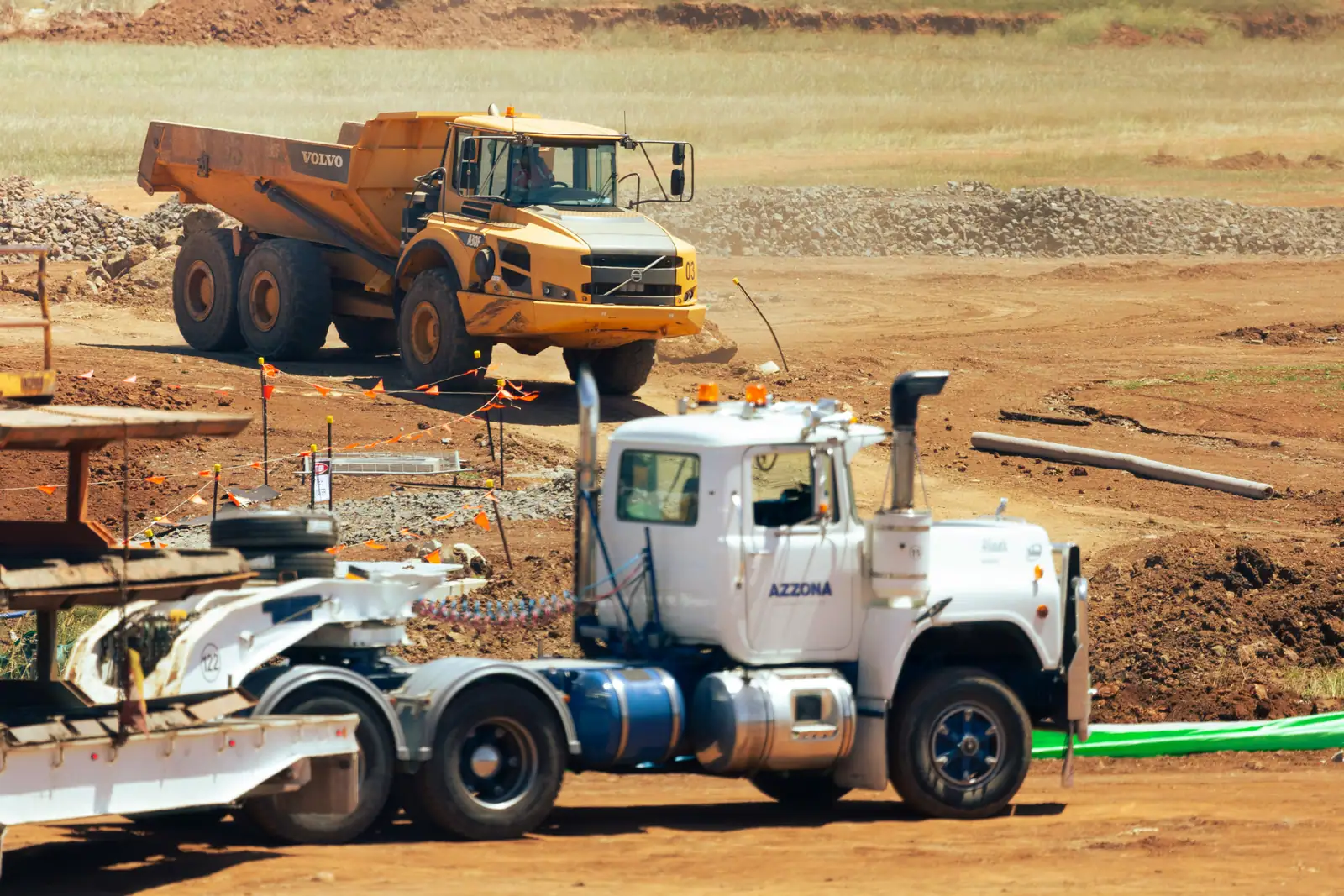
Mining, Oil and Gas
The Mining & Resources Decision Operating System
From pit to port. From well to market. One governed operating picture.
AssetStack connects extraction, processing, transport and market delivery into a single capacity-constrained flowsheet. So production, integrity, maintenance, supply and capital decisions are made on current evidence, ranked by operational consequence, and verified against actual outcomes.
- 30 to 50%Downtime reduction with integrated digital twin
- Pit → PortSingle production model across full value chain
- VerifiedEvery decision traced to evidence & outcome
The Operating Problem
Disconnected Systems. Stale Evidence. No Traceable Consequence.
Mining and oil & gas operations run the most capital-intensive, interdependent asset chains in industry. A single bottleneck, a failed haul truck, a fouled heat exchanger, a corroded pipeline circuit, a delayed critical spare, cascades from extraction through processing, transport and market delivery. Yet most operators still manage these assets in disconnected systems.
- 4+Disconnected systems typically running maintenance, production, integrity and capital planning in silos
- $1M+Cost of a single day of unplanned downtime in offshore and refinery environments
- 70%Of mining companies projected to adopt AI-driven asset management by 2026. But most still can't act on their data
- ∞Cascade potential: one failed auxiliary pump can stop a production line as surely as a primary turbine
The gap: Plants already generate plenty of data from sensors, SCADA and inspections. The challenge is not getting more data. It is making sure this data is clean, organised, connected and actionable.
Severity is the budget killer, not frequency. Leaders are responding by prioritising critical assets and lines where a single hour of lost production hurts most.
What AssetStack Does
Six Pillars of the Resources Decision Operating System
AssetStack is not another CMMS or data lake. It is the intelligence layer that sits across your existing systems and turns fragmented evidence into governed, consequence-ranked, verified action.
Source-to-Market Production Model
Extraction, mineral processing, gathering systems, pipelines, rail, ports and stockpiles are modelled as a single capacity-constrained flowsheet. Every stage carries its design capacity, current throughput, buffer, redundancy and margin-per-unit.
Operational Asset Models
Equipment, pressure systems, ground control zones, tailings facilities, safety-critical elements and SIFs are linked to the stages they serve. Condition, inspection, sensor and work-order evidence sits against the asset, not in a parallel spreadsheet.
Consequence-Ranked Reliability
Preventive, predictive and corrective work is prioritised by failure consequence, production exposure and intervention readiness, so the work that protects the most margin is done first, with parts, labour and isolation confirmed before release.
Critical Control & Integrity Assurance
Safety-critical elements, SIFs, pressure systems, tailings and ground control zones are governed against performance standards, proof-test intervals, TARP triggers and engineer-of-record requirements. Overdue verifications surface before they become major accident events.
Value-at-Stake Economics
Lost tonnes, downtime, energy, deferral and risk are translated into margin exposure and capital priority using the operator's own commodity price, recovery, utilisation and margin-per-unit. Never a generic benchmark presented as a site limit.
Governed Decisions, Verified Outcomes
Every material recommendation moves through proposal → approval → implementation → verification. Evidence basis, intervention window, consequence of deferral and acceptance criteria are retained. Outcomes are measured and the savings ledger is independently verified.
Sector Coverage
Built for the Full Resources Value Chain
From open-pit extraction to downstream processing, from gathering systems to port logistics. AssetStack models the assets, the dependencies and the economics as one integrated system.
Mining & Quarrying
Open-pit, underground and quarry operations: extraction, mobile fleet, ground control, waste and tailings, fixed plant, and the maintenance and supply chains that keep them running.
Mineral Processing
Crushing, grinding, separation, flotation, leaching, smelting, refining and materials handling, connected to throughput, recovery, ore hardness and wear-part consumption.
Oil & Gas
Upstream wells and gathering systems, midstream pipelines and pressure systems, downstream processing and storage, governed through condition, integrity, process-safety and compliance evidence.
Resource Infrastructure
Rail, ports, stockpiles, pipelines, water and power assets managed as one mine-to-market production dependency, with single-point failures and buffer capacity made visible.
Capabilities
Model. Monitor. Rank. Verify.
Integrated capabilities that close the gap between detection and action, so the degrading asset, the approaching integrity limit and the critical spare that won't arrive in time are all visible in one place.
Digital twin & production flowsheet
Source-to-Market Flowsheet
Every stage from extraction to market delivery modelled as a capacity-constrained network. Current throughput, buffer stock, redundancy and margin-per-unit are live, so the economic consequence of any outage is calculated, not guessed.
Asset Digital Twin
3D laser scans, IoT sensors, maintenance logs and engineering drawings fused into a living, evolving representation of each physical asset. Engineers visualise corrosion points, simulate stress under load and assess degradation without dismantling.
Interdependency Mapping
Single-point failures and buffer capacity made visible across the full value chain. An auxiliary pump that stops a production line is flagged with the same severity as the primary turbine it supports.
Condition, integrity & sensor intelligence
Condition-Based Maintenance (CBM)
Real-time telemetry from equipment (vibration, temperature, lubrication, fuel burn, operating time) feeds predictive models. Maintenance is triggered exactly when data indicates an impending fault, not on a fixed calendar.
Integrity Assurance
Safety-critical elements, SIFs, pressure systems, tailings facilities and ground control zones governed against performance standards, proof-test intervals and TARP triggers. Overdue verifications and bypassed trips surface before they become major accident events.
Prescriptive Alerts
Not just "elevated readings on Motor 3". The alert arrives as a diagnosis: outer race bearing defect, severity high, estimated time to failure two weeks. The work order, repair procedure and part availability are already checked.
Consequence-ranked decisions & capital priority
Value-at-Stake Economics
Lost tonnes, downtime, energy, deferral and risk translated into margin exposure using your commodity price, recovery, utilisation and margin-per-unit. Capital is allocated to the work that protects the most margin.
Reliability Execution
Preventive, predictive and corrective work ranked by failure consequence and production exposure, not just condition severity. The work that protects the most margin is done first, with readiness confirmed before release.
Energy & Emissions Tracking
A misaligned shaft increases friction. Friction increases power draw. AssetStack tracks energy data alongside vibration and thermal data, so a repair that fixes a misalignment cuts that asset's power draw for the rest of its life.
Governed decisions with traceable outcomes
Structured Decision Lifecycle
Every material recommendation moves through proposal → approval → implementation → verification. Evidence basis, intervention window, consequence of deferral, accountable role and acceptance criteria are retained in one record.
Verified Savings Ledger
Outcomes are measured against the prediction. Learning deltas are recorded. The savings ledger is independently verified, not self-attested. Your auditor can trace every dollar from board paper back to an individual inspection.
Mobile & Offline Field Support
Crews use rugged tablets to access and update records offline at remote extraction sites. Data syncs when connectivity resumes, so work orders, inspections and defect logs are never lost in the field.
Why It Matters
The Operators Who Protect Margin and Licence to Operate
Are not the ones with the most data. They are the ones who turn evidence into accountable action before the consequence arrives. AssetStack makes that the default mode of operation.
- 30 to 50%Reduction in unplanned downtime with integrated digital twin and predictive maintenanceIndustry estimates, McKinsey / GE Digital
- 8 to 12%Cost savings of predictive over preventive maintenance programsU.S. Department of Energy
- 40%Reduction in reactive maintenance achievable in under one yearGE Digital case studies
- 99.5%Reliability achieved by operators using digital twin technologyGE Digital, Chevron Wheatstone
The gap between facilities running an integrated detection-to-action stack and facilities running disconnected legacy systems is widening. The question isn't whether to close it. It's which assets to start with and how fast to scale.
See your full value chain in one governed picture
Book a demo and we'll model your extraction, processing and transport assets as an integrated production flowsheet, using your actual throughput, capacity and margin data.
Explore other industries


Get in touch
Book a working demo.
Tell us about your portfolio. We'll run a tailored session. No platform access until you're ready.
Thanks.
We'll be in touch within one business day.